
In the Negev, Israeli know-how and recycled water yield cheese and crops


After heavy but still insufficient rain in the Negev desert this spring, a visit to the area revealed tan, rocky hills swathed in green scrub, and wildflowers in low areas where rushing floodwaters pooled. Twenty-five small industries call this area home: farms, vineyards, fish farms, cattle operations, and bed-and-breakfasts.

At several of these businesses, high-tech agricultural methods are employed beneath the blazing sun to capture and reuse wastewater with surprising results.
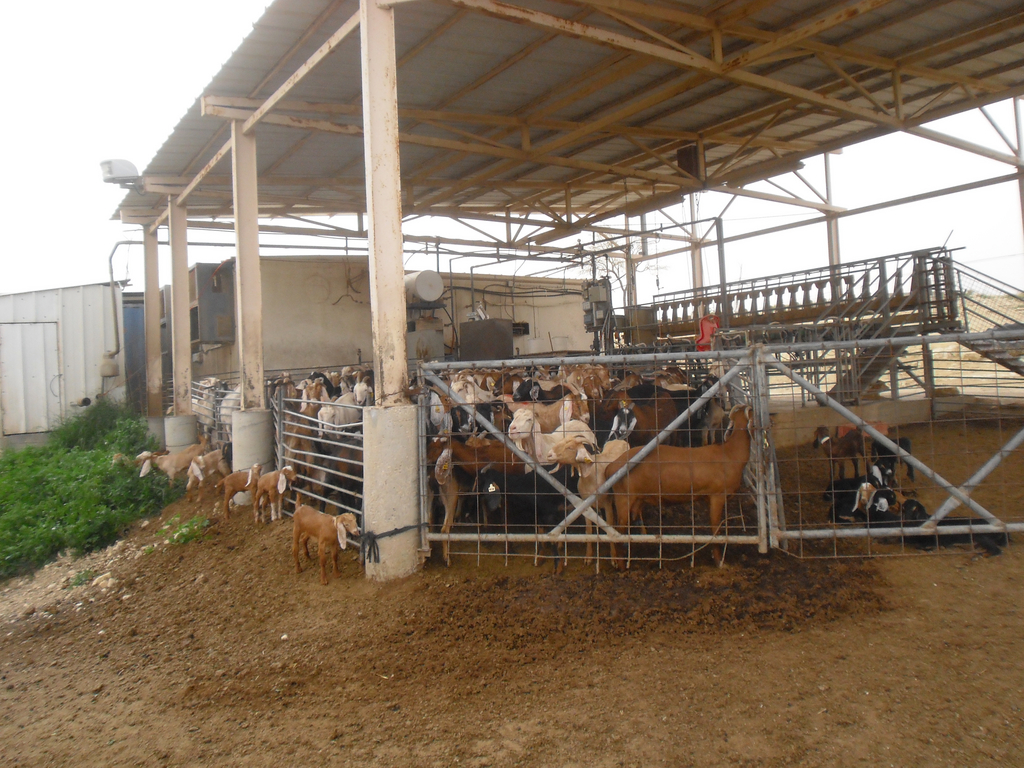
Two kilometers from the Telalim intersection, north of Sde Boker off of route 40, is a goat farm that raises award-winning cheeses while processing and reusing wastewater. Its restaurant and café looks out over the ruins of a 3000-year-old Bronze-era farm.
Anat and Daniel Kornmehl have backgrounds in animal husbandry and studied cheese making. They advise the Ministry of Agriculture on raising sheep and goats, while raising goats of their own. They established their farm in 1997 using goats from Sudan that were taken to England for breeding. Anat pointed out that the goats have especially long ears — good for ventilation in the desert. The goats’ milk is high in fat (good for taste) and high in protein (good for cheese).
“We are very isolated and waste a lot of water so we need to process the waste water from the goats,” she said.
Mike Travis came to Israel with his family from Wisconsin to get a Master’s degree and then a Doctorate focusing on the effects of oil in water in soil. He lives in Sde Boker. Over 70-percent of wastewater in Israel is reused, constituting about 20-percent of Israel’s water budget.

Most wastewater is treated in oxidation ponds, a slow process. Based on a wetland idea from France, Travis set up a garden at the Kornmehl farm to process the wastewater/gray-water — all but the toilet water.
“The water goes in one end and out the other end. Here it’s top down, it’s basically a filter, it’s a home for bacteria, they take nutrients out of the water, coat biofilms and take materials down. This wetland takes 80-percent of the impurities out of the water,” Travis said.
The garden wetland that he set up is off a patio across from the goat shed. It is a tidy square of tall pink and yellow flowering Indian Canna and pink, purple and red sage.
The goat cheese bears the regional hashgacha (kosher supervision) of Rav Suissa of the Moaitza Ayzorit and is chalav yisrael, Anat said. She is exploring other, better-known hashgachot in order to sell to a larger market.
Archeological evidence indicates a history of wine making in the area near the Boker Valley Vineyards Farm in the Negev highlands, 500 meters above sea level near Sde Boker. The nights are cold and the days are warm, ideal for wine grapes, and the climate is very dry, meaning no disease and no need to chemically treat the grapes. Moshe and Hilda Zohar built their winery themselves, a restaurant and gift shop with four “tzimmerim” (bed and breakfasts), wood chalet-type structures with thatched roofs, with help from the Jewish Agency and Israel’s Land Authority. In 1999, they planted 20 dunam of wine grapes.
Shahar Nizri, a master of science student of environmental engineering at Ben Gurion University stood by the flowering pomegranate orchard and the rows of olive trees that, only now after ending the first three years after planting, can be harvested according to halacha.
Biodiesel is currently produced from edible seeds; Nizri is currently researching use of non-edible but optimum for biodiesel castor seeds. He explained that there were different types of pomegranate trees with variations of color, redness and softness of seeds.
He also noted that pomegranate seeds should be eaten, that they are “very healthy.” “We don’t have to spray a lot,” he said, “just fertilizer.”
He also noted that the August harvest in the Negev is earlier than the rest of the country, which tends to harvest in September. The vineyards are irrigated with desalinated water from Ashkelon but they are able to use the brackish water from the aquifer for the olives and pomegranates.
“There are more polyphenols (antioxidants) with brackish water,” said Nizri. “After ten years the soil is salty, but the tree puts the salt far enough away that it doesn’t kill itself. The olive and pomegranate can continue to grow forever.”
They don’t irrigate in the winter but water everyday in the warmer weather. The watering system is underground to prevent porcupine and foxes from biting the lines, he said.
According to Zohar and Kornmehl, several of the Negev-based industries are in danger of being dismantled by the Israeli government. Although people were encouraged to build in the Negev, a public tender was not held and now the attorney general wants to evacuate the people, have a tender and sell it properly. The families who built up industries are asking for an exemption in the Knesset to prevent the destruction of all the hard work they poured into the desert. They are awaiting the decision.


